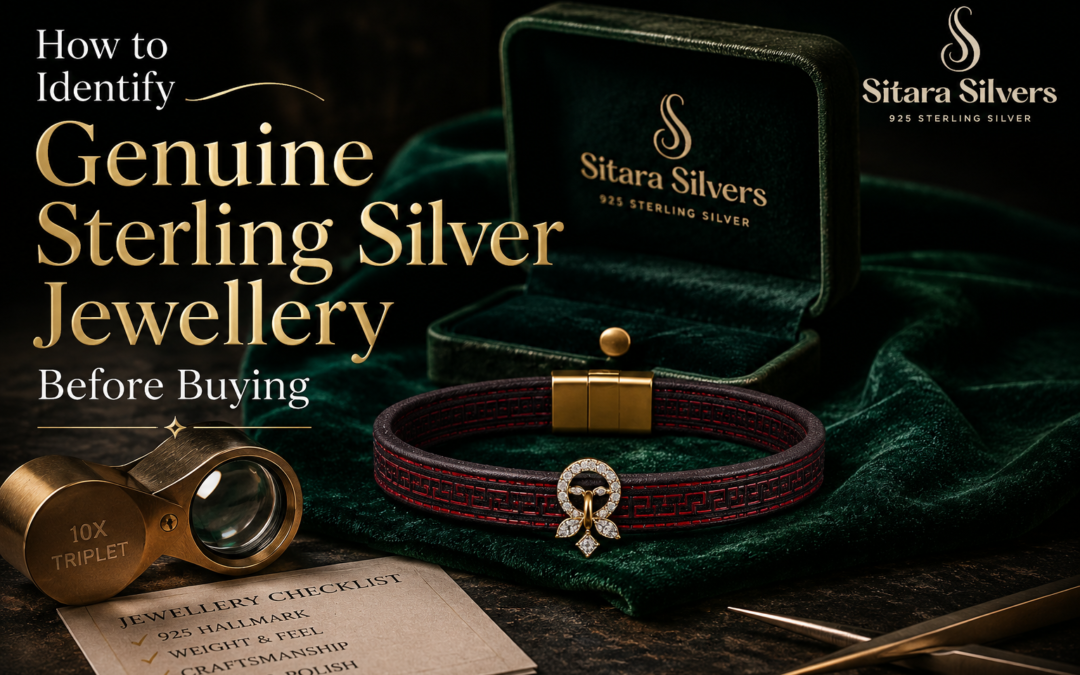
You can identify genuine sterling silver jewellery by checking for a 925 stamp, looking for BIS hallmarking, testing the piece with a magnet, and feeling its weight. Real sterling silver is never magnetic, always carries a purity mark, and feels solid rather than hollow or unusually light. A handful of home checks, done in the right order, will catch almost every common fake.
Introduction
Buying sterling silver jewellery from a shop you don’t know well always carries a small risk, and silver is one of the easiest metals to fake convincingly. A silver-plated brass ring can look identical to a genuine 925 sterling silver ring in a photo, under shop lighting, and sometimes even in person for the first few weeks of wear.
The good news is that identifying genuine sterling silver jewellery doesn’t require a lab, a jeweller’s loupe, or any special training. A short sequence of checks, done at home or right at the counter before you pay, tells you almost everything you need to know.
This guide walks through those checks in order, starting with the fastest and moving toward the more thorough ones. Along the way, we’ll cover why fake silver has become so common, how pricing should shape your expectations, what to watch for when buying online versus in person, and how to keep verified pieces looking genuine for years after you’ve bought them.
By the end, you should be able to walk into any shop, or scroll through any online store, and know within a few minutes whether what’s in front of you is real.
Why Fake Silver Jewellery Is So Common Today
Silver-plated and silver-toned jewellery has exploded in the last decade, mostly driven by fast fashion and online marketplaces where sellers can list thousands of products without much oversight. A piece described only as “silver jewellery,” with no mention of purity, is often not sterling silver at all. It’s frequently a base metal like brass, copper, or an alloy sometimes called German silver or nickel silver, coated with a thin layer of actual silver or a silver-colored finish.
This isn’t always intentional deception. Some sellers genuinely don’t know the difference between “silver-colored” and “sterling silver,” and repeat vague language they picked up from a supplier. Other times, the vagueness is deliberate, since “silver jewellery” sounds more premium than “silver-plated brass” and sells at a higher markup for a fraction of the material cost.
Either way, the responsibility usually falls on the buyer to ask the right questions, which is exactly what the rest of this guide covers.
What Genuine Sterling Silver Actually Means
Genuine sterling silver is an alloy made of 92.5% pure silver and 7.5% other metal, almost always copper. Pure silver on its own, sometimes called fine silver or 999 silver, is too soft to hold intricate shapes or survive daily wear. It bends, dents, and scratches easily.
Adding a small percentage of copper solves this. Copper strengthens the metal’s structure while barely changing its appearance, since the resulting alloy still looks bright, white, and lustrous, almost identical to pure silver to the naked eye. This 92.5 to 7.5 ratio is where the number 925 comes from, and it’s recognised as the standard for sterling silver jewellery across most of the world, including India.
The copper content also explains why sterling silver reacts to air over time. Copper is more reactive than pure silver, so it’s actually the copper in the alloy, not the silver itself, that causes most of the tarnishing you see on sterling silver jewellery. We’ll come back to this later, since it’s a useful clue when you’re trying to tell real silver from a fake.
Check for the 925 Hallmark Stamp
The most direct identifier is the number 925, stamped somewhere small and often easy to miss: the inside of a ring band, the back of a pendant, near the clasp of a bracelet, or along the edge of an earring post.
This stamp isn’t decorative. It’s applied by the manufacturer once a piece has been made to, or tested against, the sterling silver standard. If you can’t spot it with the naked eye, try your phone’s camera zoomed in, or a simple magnifying glass. Manufacturers often keep the stamp deliberately small so it doesn’t interrupt the design.
A missing stamp doesn’t automatically mean a piece is fake. Some handcrafted or vintage pieces were never stamped, especially older items made before hallmarking became standard practice in a region. But for anything bought new today, especially online, the absence of a stamp is a signal to ask more questions rather than assume the best.
Some sellers also stamp pieces with numbers that look similar but mean something different, like 800 or 900, which indicate lower silver purity used in some European and Middle Eastern jewellery traditions. These aren’t fakes, but they aren’t sterling silver either, so it’s worth knowing the difference if you’re specifically looking for 925 sterling silver jewellery.
Look for BIS Hallmarking
In India, the Bureau of Indian Standards (BIS) runs an official hallmarking scheme that certifies precious metal purity through licensed assaying and hallmarking centres. While BIS hallmarking has been made mandatory for gold jewellery sold in India, hallmarking for silver remains voluntary, though a growing number of serious sellers choose to get it done anyway, since it builds trust with buyers who know what to look for.
A BIS hallmark on sterling silver jewellery typically includes the BIS logo, the purity grade (such as 925), and often a Hallmark Unique Identification (HUID) number, which can, in principle, be traced back to the specific piece and the assaying centre that tested it.
If you’re buying sterling silver jewellery in Chennai or anywhere else in India, asking directly whether a piece is BIS hallmarked is one of the fastest ways to separate a transparent seller from one who’s being vague on purpose. A seller who hesitates, changes the subject, or gives an unclear answer is telling you something, even if they don’t say it outright.
The Magnet Test: A Quick Physical Check
Silver, in both its pure and sterling forms, is not magnetic. This makes the magnet test one of the fastest and most reliable ways to catch an obvious fake at home.
Hold a reasonably strong magnet, a small fridge magnet works fine, close to the piece. If it sticks firmly, the item almost certainly contains iron, steel, or another strongly magnetic base metal, and it is not genuine sterling silver.
If there’s no pull at all, that’s a good sign, but it isn’t a complete confirmation on its own. Some non-magnetic metals, like certain brass or aluminium alloys, can pass this test while still not being real silver. Use the magnet test as your first, fastest filter, then move on to the other checks below before making a final decision, especially for higher-value pieces.
The Weight and Feel Test
Sterling silver has a specific, fairly predictable density, roughly 10.3 grams per cubic centimetre, which gives genuine pieces a certain heft that’s difficult to replicate with hollow or lightweight alternatives.
If a ring, bracelet, or chain feels unusually light for its visible size, or sounds hollow when you tap it gently against a hard surface, that’s worth paying attention to. This isn’t a precise lab measurement, but people who handle real silver jewellery regularly start to develop an instinct for how a genuine piece should feel in the hand compared to something hollow or plated over a lighter base metal.
If you already own a piece you trust, use it as a reference point. Hold a new purchase next to it, similar in size, and compare the weight directly. The difference, when there is one, is often more obvious than you’d expect.
The Tarnish Test: What Real Silver Does Over Time
Genuine sterling silver naturally tarnishes over weeks or months of exposure to air and moisture, developing a faint grey, then eventually a darker, sometimes yellowish or black tint in areas with less air circulation, like the back of a pendant or the inner curve of a ring.
This happens because the copper in the alloy reacts with sulfur compounds naturally present in the air, forming a thin layer of silver sulfide on the surface. It’s a chemical reaction, not damage, and it polishes away easily with a soft cloth or a mild silver cleaner, revealing the bright metal underneath.
Silver-plated fakes behave differently under the same conditions. Instead of an even, gradual tarnish across the whole surface, the plating tends to wear away unevenly, usually first at points of friction like the inside of a ring, the back of an earring post, or a bracelet clasp. Once the plating wears through, it reveals a different colored base metal underneath, often yellowish brass or a dull grey nickel alloy, rather than more silver.
If you already own the piece in question and you’re unsure about its authenticity, gently rub a small, hidden area with a soft cloth and see what shows through. Even, reversible tarnish is a good sign. Patchy wear that reveals a clearly different colored metal underneath is not.
The Nitric Acid Test and Professional Assay Methods
For higher-value pieces, or when you want certainty beyond home checks, jewellers use a nitric acid test as a standard verification method. A small drop of nitric acid is applied to a discreet, unfinished part of the metal, and the resulting reaction (or lack of one) indicates whether the metal is silver, and roughly what purity it might be.
This isn’t something to attempt casually at home, since nitric acid is corrosive and needs careful handling, proper ventilation, and knowledge of how to interpret the result correctly. If you want this level of certainty, the safer route is to take the piece to a licensed jeweller or an assaying centre, many of which offer this kind of purity testing for a small fee.
For most everyday purchases, the combination of hallmark checks, the magnet test, weight, and tarnish behavior covered above will be more than enough. Save the acid test route for expensive pieces or situations where you genuinely suspect fraud and want documented proof.
Common Signs of Fake or Silver-Plated Jewellery
A few practical red flags to watch for when identifying genuine sterling silver jewellery, whether you’re shopping online or in person:
- No 925 stamp anywhere on the piece, and the seller can’t explain why or offer any purity documentation
- A price that seems far too low compared to similar pieces of the same size and design elsewhere
- Skin discoloration, usually a faint green or black mark, appearing after just a few wears, which typically points to a base metal underneath a thin silver coating
- Uneven wear that reveals a different colored metal at edges, clasps, or high-friction points within weeks of purchase
- Product listings that use vague terms like “silver-toned,” “silver finish,” or “silver plated” without stating the base metal underneath
- A seller who avoids direct questions about purity, hallmarking, or metal composition, or gives inconsistent answers when asked twice
No single item on this list proves a piece is fake. Two or more together, especially a missing stamp combined with an unusually low price, are worth taking seriously before you commit to a purchase.
Sterling Silver vs Pure Silver vs Silver-Plated vs German Silver
These terms get mixed up constantly, sometimes by sellers who don’t fully understand the difference themselves. Here’s what each one actually means:
- Pure silver (999 or fine silver) is 99.9% silver. It’s very soft, prone to scratching and bending, and rarely used for everyday jewellery, though it does appear in some coins, bars, and specialty pieces meant for display rather than daily wear.
- Sterling silver (925) is 92.5% silver mixed with a small amount of another metal, usually copper, for strength. This is the standard for good-quality jewellery meant to last, including rings, earrings, chains, and bracelets built for regular wear.
- Silver-plated jewellery is a base metal, often brass or copper, coated with a thin layer of actual silver through an electroplating process. It can look identical to sterling silver when new, but the plating wears down with regular use, usually within weeks or months, revealing the base metal underneath.
- German silver, also called nickel silver, contains no silver at all despite the name. It’s typically an alloy of copper, nickel, and zinc, valued for its silvery appearance and lower cost, but it is not silver in any meaningful sense and shouldn’t be confused with sterling silver.
Understanding where each of these sits, especially the difference between sterling silver and something that merely looks silver, makes it far easier to know exactly what you’re paying for and to spot misleading product descriptions before you buy.
Red Flags When Buying Online
Buying sterling silver jewellery online adds a layer of risk, since you can’t physically check the piece before paying. A few specific things to watch for on e-commerce listings and marketplace pages:
- Product titles or descriptions that avoid the word “sterling” entirely, using only “silver” or “silver jewellery” instead
- Stock photos that look identical across multiple unrelated sellers, which often signals a dropshipped product with no verified sourcing
- No mention of purity percentage, hallmarking, or return policy specific to purity disputes
- Reviews that focus only on delivery speed and packaging, with no mention of tarnish behavior, weight, or long-term wear
- Extremely aggressive discounting (60 to 80 percent off a supposed “original price”) on jewellery claimed to be genuine sterling silver
A seller confident in their product will usually state purity clearly in the title or first line of the description, without you having to dig for it or ask directly.
Red Flags When Buying In Store or From Local Vendors
Shopping in person gives you the advantage of handling the piece before buying, so use that advantage fully rather than relying only on what the vendor tells you:
- A vendor who’s reluctant to let you examine the stamp closely, or rushes you through the decision
- No visible price tag or documentation, with pricing that changes depending on how the conversation goes
- An unwillingness to explain the return or exchange process if a purity issue comes up after purchase
- Jewellery sold loose from a tray or cart with no packaging, certificate, or brand information at all
None of these automatically mean a piece is fake, especially with small independent artisans who may genuinely lack formal documentation. But combined with a vague answer about purity, they’re worth treating as a reason to ask more questions before paying.
Questions to Ask Before You Buy
A short, direct list of questions to ask any seller, whether you’re shopping in person or messaging an online store:
- Is this piece stamped 925, and where exactly is the stamp located?
- Is it BIS hallmarked, and can you show or send documentation for that?
- What is the exact metal composition if it isn’t pure sterling silver?
- Does the piece come with a purity certificate, invoice, or any written documentation?
- What is the return or exchange policy specifically if the purity doesn’t match what was promised?
- Can you tell me the approximate weight of this specific piece?
A seller who answers all six clearly, without hesitation or vague deflection, is generally one you can trust with your money.
Understanding Pricing: Why Genuine Sterling Silver Costs What It Costs
One of the most reliable, if imperfect, signals of authenticity is price. Silver has a real, tradable market value, which means genuine sterling silver jewellery has a price floor that plated or fake pieces simply don’t have, since they contain little to no actual precious metal.
If you see a piece marketed as solid 925 sterling silver priced far below what the raw silver content alone would cost, treat that as a serious warning sign rather than a lucky find. Legitimate sellers price in the cost of the silver itself, the craftsmanship, any stones or finishing work, and a reasonable margin. There’s only so far that price can drop before it stops making financial sense for the seller to actually be selling real silver.
This doesn’t mean the most expensive option is always the most genuine, since branding and marketing markup exist too. But an unusually cheap price on a piece claiming full sterling silver purity deserves the same scrutiny as a missing hallmark or a vague product description.
How to Store and Maintain Verified Sterling Silver Jewellery
Once you’ve confirmed a piece is genuine, a bit of ongoing care keeps it easy to verify and looking its best for years, rather than just for the first few months.
- Store pieces in a dry, airtight pouch or a box lined with anti-tarnish cloth when they’re not being worn, since prolonged air exposure speeds up the natural tarnishing process.
- Wipe jewellery with a soft, lint-free cloth after each wear to remove skin oils and moisture before storing it.
- Avoid contact with perfume, lotion, and chlorinated water, all of which accelerate tarnish and can dull the finish over time.
- Clean occasionally with a proper silver polishing cloth, rather than household chemicals or abrasive materials, which can scratch the surface.
- Take rings, bracelets, and chains off before swimming, exercising, or heavy cleaning, since sweat and chemical exposure both speed up wear.
- Revisit the hallmark stamp periodically. A stamp that stays sharp and legible over years of gentle cleaning is another quiet confirmation that the piece is genuine, solid metal rather than a thin plated layer.
With this kind of basic, consistent care, genuine sterling silver jewellery stays close to its original condition for decades, which is part of why the upfront verification effort is worth it.
How Manufacturing Affects Purity and Quality
Not all sterling silver jewellery is made the same way, and the manufacturing method can tell you almost as much as a hallmark stamp once you know what to look for.
Cast pieces are made by pouring molten sterling silver into a mould, which allows for detailed designs but can sometimes leave tiny air pockets inside the metal if the casting process isn’t done carefully. A good cast piece still feels solid and dense despite this, while a poorly made one can feel unexpectedly light for its size, similar to the weight test described earlier.
Hand-fabricated pieces are built from sheet and wire silver, shaped, soldered, and finished by a jeweller working directly with the metal. These pieces tend to be denser and more consistent in weight, since there’s less room for hidden gaps, though they usually cost more due to the labor involved.
Machine-stamped pieces, common in higher-volume production, are cut from sheet silver using dies, then shaped and finished. This method is efficient and produces very consistent results, and it’s how most everyday sterling silver rings, chains, and earrings are made today, including most pieces sold by established retailers.
None of these methods is inherently better at proving authenticity, but knowing that quality manufacturing produces consistent weight and clean, well-finished edges gives you one more thing to check alongside the stamp and the magnet test. A piece with rough, unfinished edges, visible seams that haven’t been polished smooth, or an uneven surface is more likely to be a low-effort import than a piece made with genuine care, regardless of what the listing claims about purity.
Sterling Silver and Skin Sensitivity
One practical reason purity matters beyond aesthetics and resale value is skin health. Genuine sterling silver, especially when nickel-free, is considerably less likely to cause the itching, redness, or discoloration that many people experience with cheaper metals.
Nickel is a common ingredient in low-cost silver-toned alloys and platings, and it’s one of the most frequent causes of contact dermatitis from jewellery. If you’ve ever noticed a ring or a pair of earrings leaving your skin red, itchy, or marked with a dark line after just a few hours of wear, there’s a good chance the piece contained nickel rather than being genuine sterling silver.
This is also a useful, if imperfect, authenticity signal. If you have a known sensitivity to costume jewellery but find that a specific piece never bothers your skin even after full days of wear, that’s a reasonable, though not conclusive, sign the metal underneath is genuine and free of the alloys that typically cause reactions. Buyers with sensitive skin should still confirm purity through the hallmark and other checks in this guide rather than relying on comfort alone, since reactions can take time to appear even with lower-quality metals.
Common Myths About Silver Jewellery
A few misunderstandings come up often enough that they’re worth addressing directly, since they can lead buyers to make the wrong call in either direction.
Myth: If it doesn’t turn my skin green, it must be real silver. Not necessarily. Some plated pieces use a thicker or higher-quality coating that resists skin discoloration for longer than cheaper platings, even though the base metal underneath still isn’t silver. Skin discoloration is a useful clue, but its absence alone doesn’t confirm authenticity.
Myth: Tarnished jewellery is damaged and should be thrown away. Tarnish on genuine sterling silver is a surface reaction that polishes away completely, restoring the original shine. It’s not permanent damage, and in fact, jewellery that never tarnishes at all despite years of wear is sometimes a sign it isn’t sterling silver, since a heavily lacquered or plated piece can resist tarnishing in a way real silver typically doesn’t.
Myth: Expensive always means genuine. Price is a useful signal, especially when something is priced far below the cost of raw silver content, but high prices don’t automatically guarantee purity either. Branding, packaging, and marketing markup can all inflate price without any connection to what the metal actually is. Always confirm with the checks in this guide rather than price alone.
Myth: A shiny, bright finish means it’s fake, since real silver always looks a bit dull. Genuine sterling silver, when new or freshly polished, is bright and reflective. It only develops the dull, grey tarnished look after weeks or months of air exposure. A shiny new piece isn’t automatically fake, it may simply be new or recently cleaned.
A Quick Buyer’s Checklist
For anyone who wants a fast summary to keep in mind while shopping, here’s the full identification process condensed into a single checklist:
- Look for a 925 stamp on the inside of the piece.
- Ask if it’s BIS hallmarked, and request documentation if available.
- Try the magnet test. Genuine silver will not stick.
- Check the weight against a similar piece you already trust.
- If you already own the piece, gently check a hidden area for even, reversible tarnish rather than patchy discoloration.
- Ask about the exact metal composition if purity isn’t stated clearly.
- Compare the price against the approximate cost of the raw silver content for a piece that size.
- Check the edges and finish for clean, consistent craftsmanship rather than rough or uneven seams.
- Confirm the seller’s return and exchange policy specifically for purity disputes.
- When in doubt on an expensive piece, get it verified by a licensed jeweller or assaying centre.
Keep this list in mind whether you’re standing at a jewellery counter or scrolling through an online store, and you’ll rarely be caught off guard by a fake sold as genuine sterling silver.
Where to Buy Genuine Sterling Silver Jewellery in Chennai
Once you know what to look for, buying from a seller who’s upfront about purity from the very first message makes the whole process far easier. Sitara Silvers offers sterling silver rings for women, sterling silver rings for men, sterling silver earrings, sterling silver necklaces, sterling silver bracelets, sterling silver chains for women, sterling silver kada for women, and sterling silver kada for men, with every piece stamped 925 and BIS hallmarked.
If you’re shopping for a milestone piece, the sterling silver couple rings collection is a common choice for engagements and anniversaries, and every ring in that range carries the same purity guarantee described throughout this guide.
Verifying Purity as a Gift Buyer
Buying sterling silver jewellery as a gift adds a layer most guides skip over: you’re often verifying purity for someone else’s benefit, not your own, and you may not get to see the piece worn or tested for weeks after the purchase.
If you’re buying a gift, lean harder on the checks that don’t require the recipient’s cooperation. Confirm the 925 stamp and BIS hallmark yourself before wrapping the piece, keep the invoice or purity documentation somewhere safe rather than only inside the gift box, and choose a seller with a clear return or exchange policy in case the recipient later notices an issue.
This matters especially for occasion-driven purchases like engagement gifts, anniversary pieces, or festival jewellery, where the emotional weight of the gift makes a purity problem far more disappointing than it would be with a casual personal purchase. A few extra minutes of verification before the piece is wrapped protects both the gift and the relationship behind it.
If you’re buying a matched set, such as a necklace with earrings, or a pair of couple rings, check the stamp on every individual piece rather than assuming that one verified item means the whole set is genuine. It’s not unheard of for a set to mix a verified centrepiece with lower-quality accompanying pieces, particularly with sets priced attractively low as a bundle.
Sterling Silver Resale and Long-Term Value
Authenticity checks matter for another reason beyond avoiding a bad purchase: genuine sterling silver holds long-term value in a way plated or fake jewellery never can.
Because sterling silver contains real, tradable silver, it retains a baseline melt value tied to the silver market, separate from the craftsmanship or design of the piece. This means a genuine sterling silver ring, chain, or bracelet you buy today isn’t just a purchase, it’s also a small store of value that can, in principle, be resold, exchanged, or even melted down and reworked decades later if styles or needs change.
Plated jewellery has none of this. Once the coating wears through, there’s nothing of meaningful value left underneath, and most plated pieces end up discarded rather than resold or repurposed. This is one of the quieter reasons verified purity matters so much when buying, since it affects not just how a piece looks and feels today, but what it’s actually worth years down the line.
If resale or long-term value matters to you, especially for larger purchases like a set of couple rings or a substantial necklace, ask the seller directly whether they offer any buy-back or exchange program based on silver weight. Established sellers who stand fully behind their purity claims are often willing to offer this, since they know exactly what they’ve sold you and are confident it will hold up to scrutiny later.
Internal References
- Sitara Silvers Homepage
- Sterling Silver Rings for Women
- Sterling Silver Rings for Men
- Sterling Silver Earrings
- Sterling Silver Necklaces
- Sterling Silver Bracelets
- Sterling Silver Chains for Women
- Sterling Silver Kada for Women
- Sterling Silver Kada for Men
- Sterling Silver Couple Rings
External References
- Sitara Silvers on Instagram
- Bureau of Indian Standards (BIS), for the hallmarking scheme referenced in this article. Link to the official BIS website once you confirm the exact page you want cited.
A note on the Instagram link: it’s included here as a brand reference, not as a source backing a factual claim, so treat it as a “follow us” style reference rather than a citation. If you want it to actually pass SEO value back to your Instagram profile, keep the link exactly as you use it in your official bio and other listings, so search engines see it consistently across your web presence.
Frequently Asked Questions
Q: What is the easiest way to identify genuine sterling silver jewellery? Check for a 925 stamp on the piece, usually inside a ring band or near a clasp. Combine this with a BIS hallmark check if you’re buying in India, and you’ll catch most fakes before you pay.
Q: Does real sterling silver stick to a magnet? No. Genuine silver is not magnetic. If a piece sticks firmly to a magnet, it likely contains iron or another magnetic base metal and isn’t real sterling silver.
Q: Why does sterling silver tarnish, and does that mean it’s fake? Tarnish is a natural reaction between the copper in sterling silver and sulfur compounds in the air. It doesn’t mean the piece is fake. Even tarnish that polishes away cleanly is actually a sign the piece is genuine, since plated fakes tend to wear unevenly instead.
Q: What’s the difference between sterling silver and pure silver? Pure silver is 99.9% silver and too soft for most jewellery. Sterling silver is 92.5% silver mixed with a small amount of another metal, usually copper, which makes it strong enough for daily wear while keeping the same bright finish.
Q: What is German silver, and is it the same as sterling silver? No. German silver, also called nickel silver, contains no actual silver. It’s an alloy of copper, nickel, and zinc that looks silvery but has none of the properties or value of genuine sterling silver.
Q: Can I test silver jewellery at home without special tools? Yes. The magnet test, the weight and feel check, and looking closely for a 925 stamp can all be done at home with no special equipment. These won’t replace a professional purity test, but they catch most obvious fakes.
Q: Is BIS hallmarking required for silver jewellery in India? BIS hallmarking is currently mandatory for gold jewellery in India, while silver hallmarking is voluntary but strongly recommended. A BIS hallmark on silver jewellery is a strong signal that the piece has been independently tested for purity.
Q: Why is genuine sterling silver jewellery more expensive than silver-plated jewellery? Sterling silver contains real, tradable precious metal, which gives it a price floor plated jewellery doesn’t have. Plated pieces are made from cheaper base metals with only a thin silver coating, so they cost far less to produce.
Q: Can sterling silver jewellery be resold or exchanged later? Yes, since genuine sterling silver holds real value tied to the silver market. Many established sellers offer buy-back or exchange programs based on silver weight, which is one more reason to buy from a seller who’s transparent about purity from the start.
Q: Should I verify every piece in a matched jewellery set? Yes. Check the stamp on each individual piece in a set, such as a necklace and earring pair, rather than assuming one verified piece means the whole set is genuine, especially with attractively priced bundles.
Conclusion
Identifying genuine sterling silver jewellery comes down to a short list of habits: check for the 925 stamp, look for BIS hallmarking, try the magnet test, pay attention to weight, and understand how real silver tarnishes compared to plated fakes. None of this takes special training or equipment, just a few minutes of attention before you hand over your money.
Buying from a seller who’s transparent about purity from the very first message makes all of this easier, and it’s worth choosing that kind of seller even if it means paying slightly more than the cheapest option you find. If you’re looking for BIS hallmarked, genuinely stamped 925 sterling silver jewellery in Chennai, explore Sitara Silvers’ collection and buy knowing exactly what you’re getting.